
Imagine peering into the universe’s past, glimpsing an era when it was still in its infancy. Such an opportunity could be afforded by a ten-second signal, older than our own Sun. This cosmic whisper holds secrets waiting to be unraveled, promising insights into the universe’s earliest moments. But what does this mysterious echo from the distant past signify, and why is it so crucial for our understanding of space? Stay with us as we journey through the cosmos to uncover the importance of this extraordinary discovery.
An Echo from a Distant Time
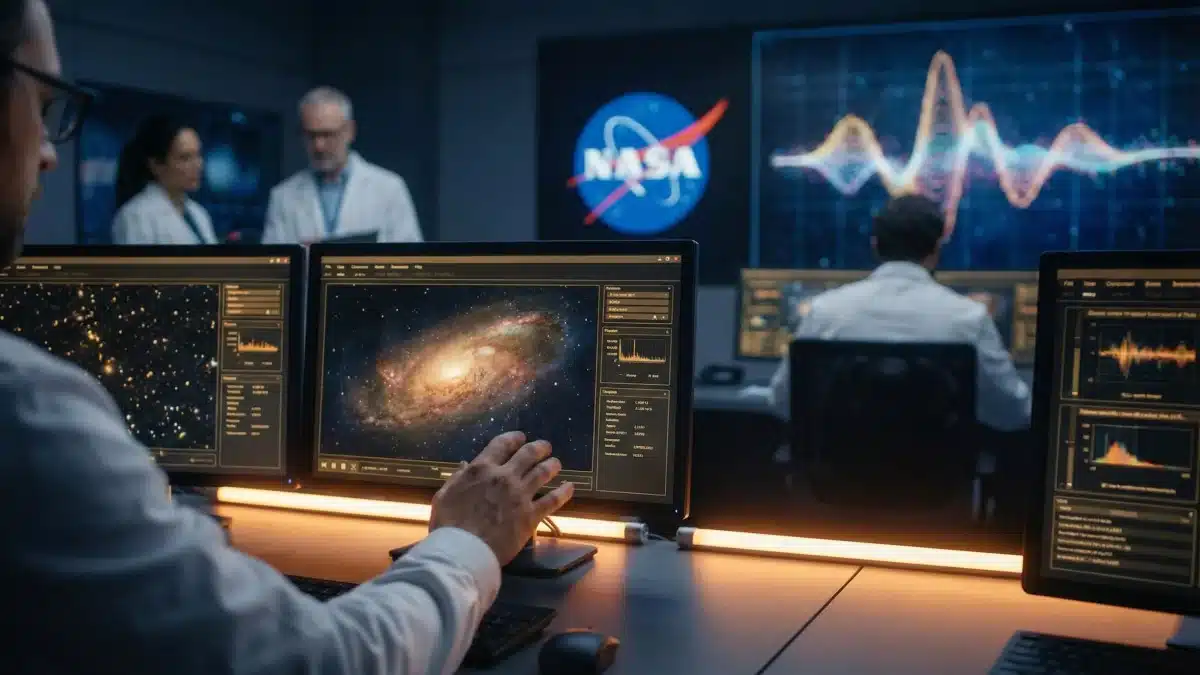
In a room where silence reigns, interrupted only by the soft hum of a server rack and the rhythmic clatter of keyboards, the NASA Goddard Space Flight Center becomes the stage for a remarkable event. On one of their screens appears a thin, jagged line – a ten-second data recording that might just be the key to unlocking the universe’s most profound mysteries. What does this signal, this cosmic whisper, really tell us about the cosmos’s infancy?
The Thrilling Discovery: What’s Behind the Signal?
Imagine stumbling upon a message sent over 13 billion years ago. If you think this is merely another random anomaly, think again. Scientists suspect it to be a fast radio burst (FRB), a phenomenon typically emerging from the “younger” cosmic history. However, this signal stands apart as it emerges from a time shortly after the ignition of the first stars. Why is this momentous, you might ask? Discover how this signal sheds light on the universe’s early chapters.
The Journey of This Mysterious Signal
Visualize radio waves traversing the vast expanses of the expanding universe, eventually reaching NASA’s sensitive antennas. This isn’t just any signal; its value to scientists is priceless. It carries clues about the state of the early universe, a period characterized by density, heat, and turbulence. But what exactly can we learn from this ten-second signal? Let’s delve deeper.
Decoding a Ten-Second Signal: What Can We Learn?
Through meticulous analysis of the signal’s stretching and frequency scattering, researchers can reconstruct the density of the material it passed through. Was the universe filled with ionized gas? Were primitive galaxies already forming? Each tiny ripple in this line might answer one of these questions – or perhaps pose new ones. What insights might we gain from investigating these cosmic imprints?
How NASA Captured a Cosmic Whisper
Is this just a matter of luck? In reality, it’s the fruit of years of painstaking preparation and precise calibration. NASA’s engineers have trained radio telescopes to be ever-ready, capable of detecting even the slightest anomalies in the sky. But how do they sift through the immense data to find the real gems? Uncover the meticulous process behind this cosmic discovery.
The Behind-the-Scenes Effort
This achievement is the result of a dedicated team of specialists working tirelessly behind the scenes to decode these signals. Their perseverance transformed a fleeting blip into a groundbreaking discovery now presented on your screen. What does it take to achieve such a feat, and what motivates these unsung heroes of science?
Why Does This Matter to Us All?
Do you need a PhD to grasp the significance of this discovery? Absolutely not. When you hear “13 billion years,” let that sense of awe wash over you. The realization that our existence is but a brief moment in this grand cosmic concert can be overwhelming, yet also deeply inspiring. It’s these small moments of insight that expand our understanding of the universe and remind us that curiosity is not a test to pass; it’s an invitation to explore whenever something captivates us, even if just for a moment.
In the end, this cosmic discovery isn’t just a scientific milestone; it’s a window into our universe’s past, prompting us to ponder our place within it. So, what other mysteries of the cosmos are waiting to be uncovered, and how will they change our understanding of the world we live in? Keep exploring, as the universe has much more to offer than we can imagine.