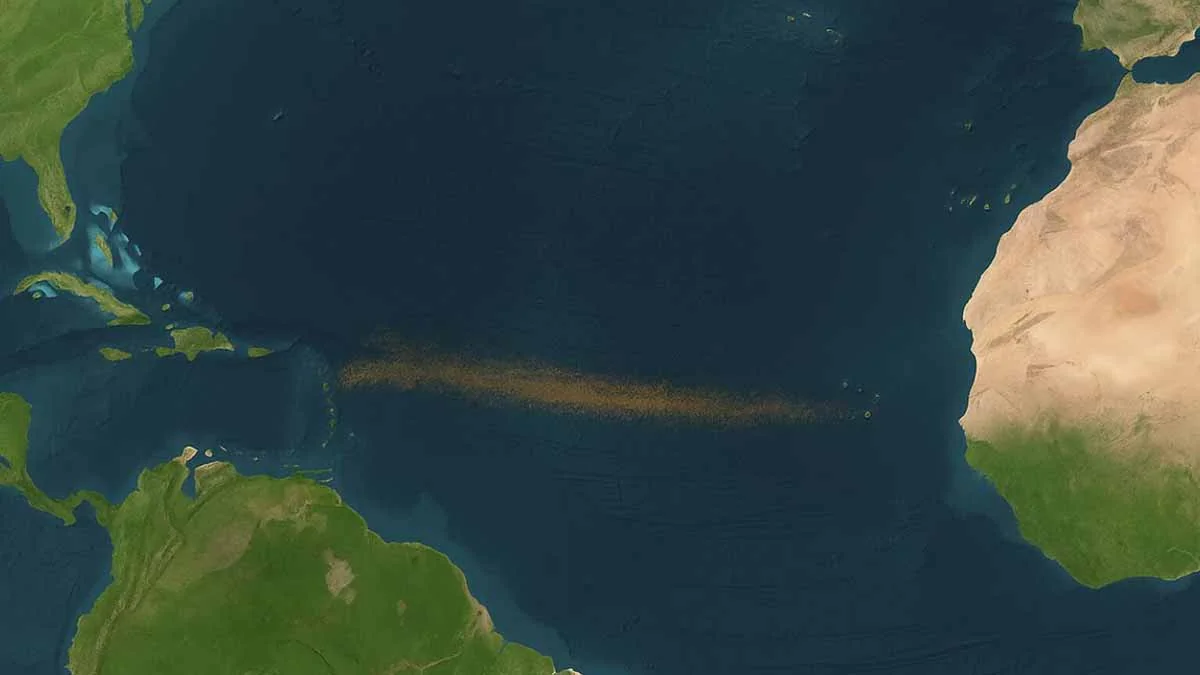
Imagine the Atlantic Ocean as a vast blue expanse, suddenly disrupted by a colossal brown ribbon stretching from Africa to America. Fifteen years ago, no one mentioned it. Today, this floating continent of sargassum seaweed is causing alarm among fishermen, scientists, and tourists alike. Satellite images don’t lie: this proliferation threatens beaches, biodiversity, and even ports. What was once a silent phenomenon has become a global emergency, visible from space.
The Floating Continent Altering Our Oceans
In 2011, the idea of sargassum overtaking the Atlantic seemed far-fetched. Fast forward to May last year, when a staggering 37.5 million tons of brown algae formed an 8,850 km ribbon, more than twice the width of a continent. Originally confined to the Sargasso Sea, these plants now thrive as far as the Gulf of Mexico, as if the ocean itself has lost its bearings.
According to a recent study reported by futura-sciences.com, using forty years of satellite data, the growth of this phenomenon is undeniable. Researchers at the Harbor Branch Oceanographic Institute have confirmed that the Great Atlantic Sargassum Belt (GASB) did not exist before 2011. By 2025, its record-breaking expansion marks a dramatic shift. It’s no longer a seasonal tide but a permanent presence, slowly suffocating marine balance.
Remember 1991, when a nuclear plant in Florida had to close its doors, overwhelmed by these algae? Since 2004, the Gulf of Mexico has witnessed giant “windrows” accumulating each year. These massive beachings are more than a nuisance; they destroy reefs, suffocate seabeds, and cost coastal communities millions.
Why Is This Seaweed Continent Growing Relentlessly?
The root cause lies in an excess of nutrients. Between 1980 and 2020, the nitrogen content in sargassum increased by 55%. The secret to their rapid growth? In nutrient-rich waters, they double their biomass in just eleven days. These nutrients are no longer just ocean-born: agricultural runoff, wastewater, and atmospheric deposits now fuel this proliferation.
The Amazon River plays a pivotal role. Its annual floods discharge tons of nutrients into the Atlantic, boosting the sargassum. Conversely, droughts temporarily slow their expansion. However, with climate change, these natural cycles are escalating. As a result, currents like the Gulf Stream transport these vegetative masses over thousands of kilometers, creating monstrous accumulations.
Eutrophication, the overabundance of nutrients in the water, is no longer a simple coastal problem. It now shapes the entire ocean. Each year, scientists observe one thing: as oceans warm, sargassum thrives. A vicious cycle threatening to worsen.
A Threat to Marine Life and Our Economies
While sargassum provides habitat for fish, turtles, and invertebrates, its excess becomes toxic. As it decomposes, it releases hydrogen sulfide, a deadly gas that creates lifeless zones. Beaches, buried under brown sludge, lose their tourist appeal. In Miami or Cancún, cleaning costs soar, straining local budgets.
Its degradation also emits methane, a potent greenhouse gas. These emissions, still poorly quantified, could amplify global warming. Imagine: the hotter the oceans become, the more sargassum grows, releasing even more gas. A dangerous feedback loop, difficult to stop.
In response to this crisis, scientists are sounding the alarm. International monitoring is essential, as are improved predictive models. But most importantly, we must address the root cause: reduce agricultural fertilizers, treat wastewater, and protect wetlands. The goal? To preserve not just coastlines, but the entire global ocean.
The Ocean Is Sending Us an Urgent Message
This brown ribbon is more than a summer nuisance: it signals a profound transformation of our seas. With climate change, other regions could soon face similar brown tides. Acting now means saving our beaches, our fisheries, and even our climate. This continent of algae reminds us of a simple truth: the health of the oceans is our own. And every action counts. Discover how we can safeguard our blue planet before it’s too late.