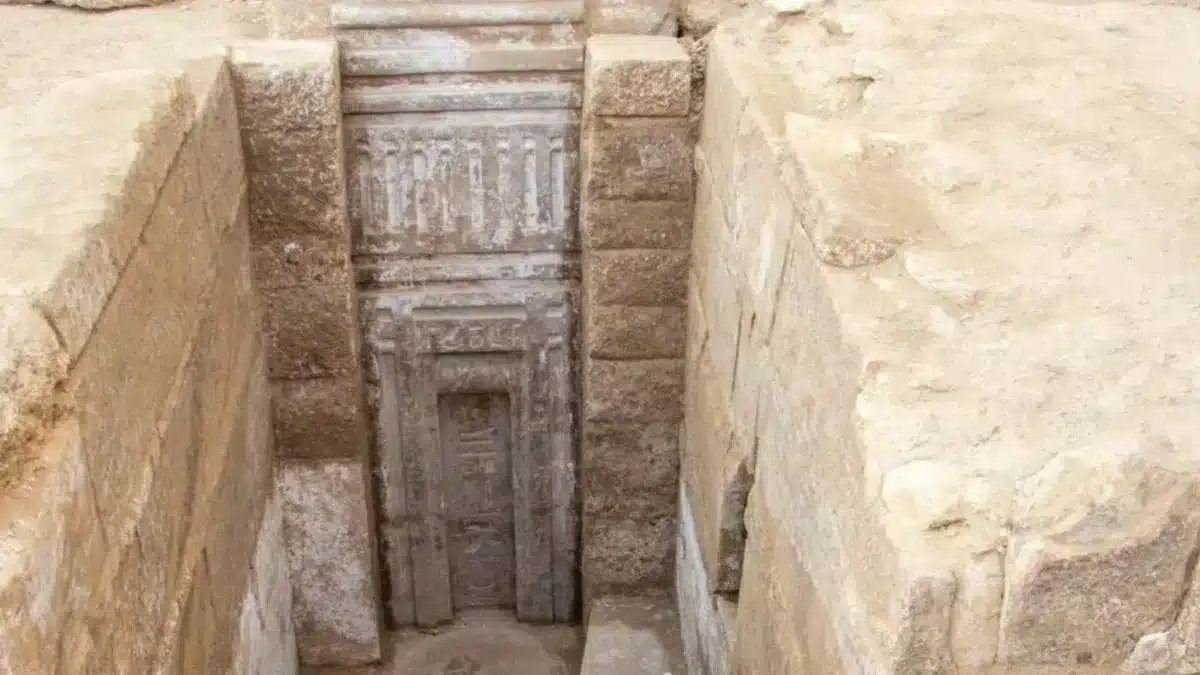
Imagine stepping into the mysterious realm of ancient Egypt, where each discovery unravels secrets of a civilization long past. Recently, archaeologists in Saqqara, a site renowned for its ancient necropolis, have unearthed something truly astonishing: a colossal pink granite false door in the tomb of Prince Waser-If-Rê. But what could this monumental find reveal about the burial practices and societal structures of the Old Kingdom? The answers might surprise you.
An Architectural Marvel: The Pink Granite Door
The discovery of the pink granite door stands as a testament to the grandeur of ancient Egyptian architecture. Standing over 4.2 meters high, this imposing structure was not meant as a physical entryway, but rather as a symbolic portal connecting the world of the living with the afterlife. Such use of rare material underscores the distinguished status of Prince Waser-If-Rê, a notable figure in the royal hierarchy, being the son of King Userkaf. Intricate hieroglyphs carved into the door detail the numerous prestigious positions he held.
Unveiling the Tomb’s Treasures
Dr. Zahi Hawass, a renowned Egyptologist leading the excavation team, unearthed a trove of ceremonial artifacts within the tomb. Among the finds were thirteen high-backed chairs adorned with finely crafted statues of pink granite, thought to represent the prince’s consorts. Interestingly, two statues were found beheaded, raising questions about possible vandalism or ritualistic practices.
The burial chamber is dominated by a massive offering table made from red granite, etched with detailed inscriptions about sacrificial ceremonies dedicated to Egyptian deities. Nearby, an overturned statue of black granite suggests complex religious rites were performed to guide the prince’s soul in the afterlife. The extraordinary scale and quality of these artifacts reflect the vast resources once commanded by this royal figure.
The Intriguing Titles of Prince Waser-If-Rê
The prince’s significant roles are immortalized on the false door, highlighting titles such as:
- Heir Prince of the Royal Line
- Supreme Vizier of the Pharaoh
- Governor of Buto and Nekheb
- Royal Advisor and Confidant
A secondary granite entrance adorned with the cartouche of King Neferirkare points to complex political connections within the ruling class, shedding light on the power dynamics of that era.
Cross-Dynastic Mysteries and Modern Research Techniques
One fascinating detail about this archaeological find lies in the presence of elements from different time periods. Though the tomb is linked to the Old Kingdom, certain clues suggest later reuse, possibly during the 26th Dynasty. Statues of King Djoser, his queen, and their ten daughters appear to have been transferred into the tomb centuries after its original construction.
This relocation of royal artifacts raises questions about protective measures against grave robbers or genealogical links between dynasties separated by time. Researchers are employing cutting-edge technologies such as carbon-14 dating and spectral imaging to unravel these lingering mysteries. These innovative methods promise new insights in the months to come, as archaeologists continue to make groundbreaking discoveries that shake our understanding of ancient civilizations.
The Broader Implications for Egyptological Research
The ongoing excavations at Saqqara consistently bring extraordinary finds to light. The pink granite door serves as powerful evidence of Prince Waser-If-Rê’s importance in Egyptian history, shedding light on an era where burial architecture both manifested power and aimed to preserve the soul for eternity. This monumental discovery significantly expands our understanding of the social hierarchies and religious practices of this fascinating civilization.
As archaeologists continue their work, the story of Prince Waser-If-Rê and his grand tomb will undoubtedly contribute to the rich tapestry of Egypt’s ancient past, offering new chapters and insights into a world that continues to captivate our imagination. What other secrets lie buried beneath the sands of time, waiting to be discovered?